Medical
Medical Electronics and MLCC Reliability
Medical electronic devices operate at the intersection of stringent safety standards (IEC 60601), extreme reliability requirements, and rapid technological advancement. From the patient-worn Holter monitor recording ECG for 48 hours to the MRI scanner generating 3-Tesla magnetic fields, MLCCs play critical roles in signal conditioning, power management, isolation, and EMI suppression across the medical device spectrum.
The defining characteristic of medical-grade electronics is patient safety. IEC 60601-1 mandates two means of patient protection (MOPP) for applied parts, requiring galvanic isolation between the patient-connected circuits and earth-ground-referenced electronics. MLCCs used in isolation barriers — particularly Y-class safety capacitors bridging primary-to-secondary isolation in medical power supplies — must meet enhanced safety requirements with guaranteed failure-open behavior.
Beyond safety, medical devices must meet extreme reliability targets. An infusion pump delivering life-sustaining medication cannot fail. A defibrillator must discharge reliably when needed. These near-zero-failure-tolerance requirements drive conservative design practices: extensive voltage derating, high-reliability dielectric selection, and comprehensive component qualification beyond standard commercial screening.
Medical Power Supply Requirements
Medical AC-DC Power Supplies: Medical-grade power supplies must provide 4,000VAC (2× MOPP) or 1,500VAC (1× MOPP) isolation between primary and secondary. Y1 safety capacitors (rated 500VAC, impulse tested to 8kV) bridge the primary-secondary isolation barrier for EMI suppression. These capacitors must be specifically certified to IEC 60384-14 for Y1 safety classification and must fail open — never short — under any fault condition.
Leakage Current Limits: Medical equipment patient leakage current is limited to 10µA under normal conditions and 50µA under single-fault conditions. Y-capacitors on the isolation barrier directly contribute to leakage current through their inter-winding capacitance. This imposes an upper limit on the Y-capacitor value — typically ≤ 2.2nF for 2× MOPP designs at 240VAC/50Hz. Low-leakage EMI filter designs may use active EMI cancellation to meet both emission and leakage requirements.
DC-DC Converters in Patient Circuits: Isolated DC-DC converters powering patient-connected circuits must meet IEC 60601-1 isolation requirements. Output filtering and decoupling MLCCs are typically X7R dielectric rated 25V–50V in 0603–1206 packages. The key requirement is reliability: these capacitors protect circuits that directly contact patients, so conservative derating (≥ 50% voltage, ≥ 70% temperature) is standard practice.
Diagnostic and Imaging Equipment
Ultrasound Systems: Modern ultrasound machines use multi-element phased-array transducers with 128–256 channels, each requiring high-voltage transmit pulses (±50V to ±100V). The transmit beamformer uses C0G MLCCs rated 200V–500V in 0805–1210 packages for pulse-shaping networks. Receive signal conditioning requires ultra-low-noise amplifiers decoupled with 0402 X7R MLCCs.
MRI Systems: MRI gradient amplifiers switch hundreds of amperes at multi-kHz frequencies to create spatial encoding gradients. The DC-link requires large banks of high-voltage MLCCs (500V–1kV, X7R) for energy storage and ripple filtering. The extreme magnetic field environment (1.5T–7T) means all capacitors must be non-magnetic — nickel-barrier terminations with tin plating are replaced with palladium-silver or gold terminations to prevent magnetic force attraction.
CT Scanners: CT gantry electronics rotate at 3–4 revolutions per second while acquiring data from hundreds of detector channels. MLCCs on the rotating assembly experience both centrifugal acceleration and vibration. Soft-termination or lead-frame MLCC packaging is specified to prevent mechanical cracking, while the slip-ring power transfer system uses high-voltage MLCCs for the rotating-side DC-link filtering.
Portable and Wearable Medical Devices
Wearable Patient Monitors: Continuous vital-sign monitoring wearables operate from coin-cell or rechargeable Li-ion batteries. Every microamp of quiescent current matters for battery life measured in days or weeks. MLCC selection emphasizes low leakage current and ultra-small packages: 0201 and 0402 X5R MLCCs for MCU/sensor decoupling, with careful attention to DC bias characteristics since battery voltages (1.8V–4.2V) can cause significant capacitance loss in low-voltage-rated MLCCs.
Hearing Aids: Modern digital hearing aids pack DSP, wireless radio (Bluetooth LE), multiple microphones, and a rechargeable battery into a device smaller than a fingertip. This extreme miniaturization drives the use of 01005 MLCCs (the smallest commercially available package at 0.4mm × 0.2mm). Capacitance values are small (100pF–100nF) but must maintain stability across the body-temperature range (25°C–40°C) with ppm-level reliability.
Implantable Devices: Pacemakers and neurostimulators operate inside the human body for 7–15 years on a single battery. The MLCCs in these devices are subject to the most extreme reliability requirements in all of electronics. Hermetic packaging, precious-metal electrodes, and comprehensive lot-level burn-in screening are standard. The ceramic dielectric must maintain stability in the 37°C body-temperature environment with zero parametric drift over the device lifetime.
Medical MLCC Selection Guidelines
Safety Compliance: For capacitors bridging isolation barriers, only use Y1 or Y2 safety-certified capacitors with appropriate agency markings (UL, CSA, VDE, IEC). Never substitute a standard capacitor for a safety capacitor — the failure mode, test qualifications, and regulatory acceptance are fundamentally different.
Dielectric Selection: C0G/NP0 for precision analog circuits, timing, and high-frequency applications. X7R for general decoupling and filtering where moderate capacitance stability is acceptable. Avoid X5R in medical applications where the device may experience temperatures above +85°C (e.g., near power stages or in sterilization environments).
Voltage Derating for Medical: Medical industry best practice is ≥ 50% voltage derating for non-safety applications and ≥ 60% for patient-connected circuits. This is more conservative than commercial practice to reflect the near-zero-failure-tolerance requirement and the regulatory expectation that "reasonably foreseeable misuse" must not create a hazard.
Change Control: Medical device regulations (FDA 21 CFR Part 820, EU MDR 2017/745) require strict component change control. Any change to an MLCC — even a different production lot from the same manufacturer — may require design review, verification testing, and possibly regulatory re-submission. Work with suppliers who provide long-term component availability commitments and proactive end-of-life notifications.
510 MLCC Capacitors for Medical
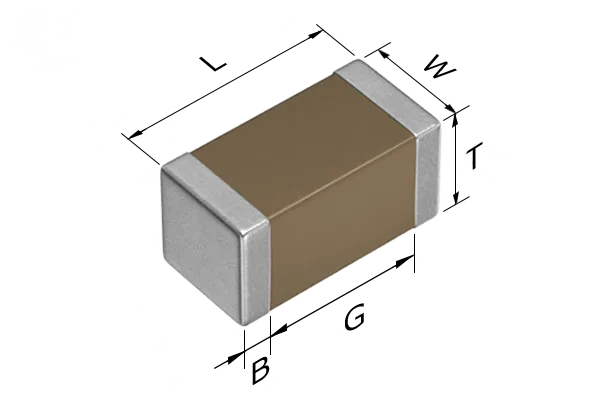
GRM188R71E104KA01D
603 · 25V · 100NF · Murata
GRM188R61A106ME69D
603 · 10V · 10UF · Murata
GRM188R6YA106MA73D
603 · 35V · 10UF · Murata
GRM188R61A105KA61D
603 · 10V · 1UF · Murata
GRM188R61A335KE15D
603 · 10V · 3.3UF · Murata
GRM188R60J475KE19D
603 · 6.3V · 4.7UF · Murata
GRM188R61A475KE15D
603 · 10V · 4.7UF · Murata
GRM188R61A225KE34D
603 · 10V · 2.2UF · Murata
GRM188R61C106MA73D
603 · 16V · 10UF · Murata
GRT188C81C106ME13D
603 · 16V · 10UF · Murata
GRM188R61C225KE15D
603 · 16V · 2.2UF · Murata
GRM188R61C475KE11D
603 · 16V · 4.7UF · Murata
GRM188R61C474KA93D
603 · 16V · 470NF · Murata
GRM188R61E106KA73D
603 · 25V · 10UF · Murata
GRM188R61E106MA73D
603 · 25V · 10UF · Murata
GRM188R60J106KE47D
603 · 6.3V · 10UF · Murata
GRM188R60J106ME47D
603 · 6.3V · 10UF · Murata
GRM188R60J226MEA0D
603 · 6.3V · 22UF · Murata
GRM188R60J476ME15D
603 · 6.3V · 47UF · Murata
GRM188R71A225KE15D
603 · 10V · 2.2UF · Murata
GRM188R61C105KA12D
603 · 16V · 1UF · Murata
GRM188R71C224KA01D
603 · 16V · 220NF · Murata
GRM188R71C334KA01D
603 · 16V · 330NF · Murata
GRM188R71E105KA12D
603 · 25V · 1UF · Murata
Showing 24 of 510 products. Visit a brand page to filter by specific parameters.