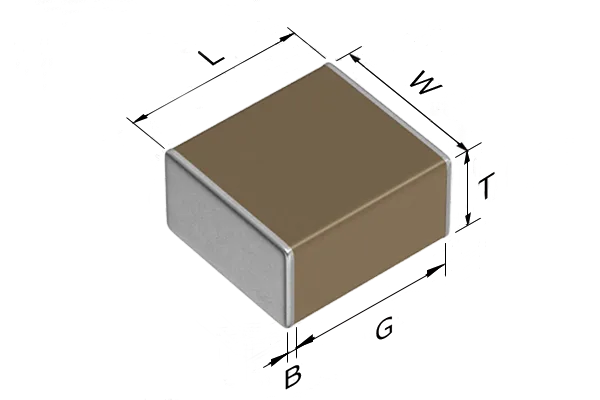
Automotive-Grade MLCC Selection Guide — Choosing the Right SMD Capacitor for Vehicle Electronics
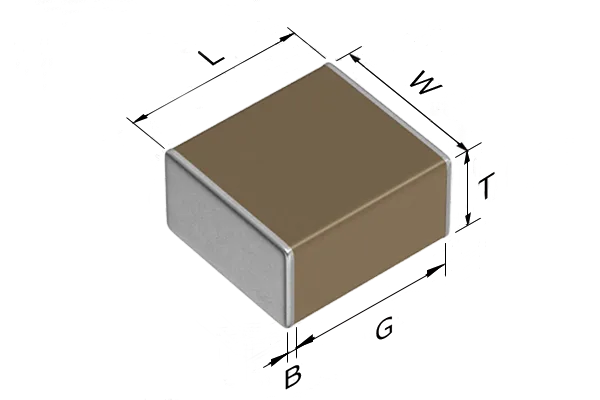
Core Differences: Automotive vs. Consumer MLCCs
The automotive electronics environment imposes far stricter requirements on MLCCs than consumer electronics. Automotive-grade MLCCs must pass AEC-Q200 qualification — the passive component stress test standard covering temperature cycling, humidity aging, mechanical shock, terminal strength, and dozens more reliability tests. This is the fundamental divide between automotive and consumer-grade products.
For temperature, automotive MLCCs typically must operate from -55°C to +125°C, with components near the engine compartment requiring up to +150°C. By contrast, consumer-grade X5R capacitors are only guaranteed over -55°C to +85°C — wholly inadequate for automotive use.
Additionally, automotive products require full batch traceability and PPAP (Production Part Approval Process) documentation that consumer products do not. If a batch has issues, every step from raw material to finished process must be traceable.
Dielectric Selection: X7R Is the Workhorse, but Not Always Enough
X7R (-55°C to +125°C, ±15% capacitance change) is the dominant dielectric for automotive MLCCs. It serves decoupling and filtering in infotainment, body control, LED lighting, and most other modules. X7R accounts for over 70% of all automotive MLCC shipments.
X8L / X8R (-55°C to +150°C) is required for modules near the engine, transmission, and other high-temperature zones. As ECU integration increases and engine-bay electronics proliferate, X8 demand is growing significantly faster than X7R. Note that X8 types generally offer narrower capacitance ranges and cost 30-50% more.
C0G/NP0 (±30ppm/°C temperature coefficient, near-zero drift) is the go-to for resonant circuits, timing circuits, and sensor signal conditioning. In ADAS mmWave radar, LiDAR, and automotive high-frequency communication modules, C0G's temperature stability is irreplaceable. However, its capacitance ceiling is typically in the nF range — insufficient for power rail decoupling.
A common mistake is reaching for Y5V in high-temperature scenarios to save cost. Y5V can lose over 80% of its capacitance at +85°C, with terrible aging characteristics. Automotive applications should completely avoid Y5V/Z5U dielectrics.
DC Bias Behavior — The Hidden Trap in Automotive Power Design
With new energy vehicle battery voltage platforms (48V mild hybrid, 400V/800V high-voltage systems), DC bias derating becomes a critical selection factor. A nominal 10µF, 50V-rated 1206 X7R MLCC may deliver only 30-40% of its rated capacitance at 40V DC bias.
Mitigation strategies:
- Choose a higher voltage rating — e.g., specify 100V or 250V for a 48V system rather than a 50V part that barely meets the voltage requirement
- Prefer larger package sizes — 0805 has better bias stability than 0603, and 1206 is markedly better than 0805
- Where space permits, use parallel smaller-value capacitors instead of a single large-value part — this improves bias behavior and aids thermal dissipation
For resonant tank capacitors in automotive DC-DC converters and OBCs (on-board chargers), DC bias characteristics directly impact conversion efficiency. For these applications, strongly consider C0G dielectric, or verify that the chosen X7R's effective capacitance at maximum operating voltage meets design margin requirements.
Soft Termination Technology — The Key to Vibration Survival
Continuous vibration during driving and PCB deformation from thermal cycling are the #1 cause of MLCC failure in vehicles. Standard MLCCs readily develop cracks when the PCB flexes — flex cracks are the most common automotive MLCC field failure mode, leading to shorts or leakage.
Soft Termination (Flex Termination) technology embeds a conductive silver-polymer layer in the terminal electrode, effectively absorbing mechanical stress. Manufacturer product families:
- TDK: CGA series (soft termination)
- Murata: GCJ series
- Yageo: AC series (automotive flex terminal)
- Walsin: WF series
- Samsung: AEC-Q200 qualified models in CL31/CL32 families
Recommendation: Strongly consider soft termination versions for capacitors mounted near PCB edges, near connectors or mounting holes, and for larger packages (1206 and up). The 10-20% cost premium is far outweighed by reduced field failure rates — the yield improvement alone more than justifies the BOM cost increase.
Application-Specific Selection Strategies
Powertrain & Electric Drive (motor controllers, inverters, DC-DC)
- Dielectric: X7R primary; X8L for high-temperature nodes
- Package: 0805-1210; 1206+ for bulk filtering
- Voltage: 100V-630V (NEV high-voltage platforms)
- Key concerns: DC bias behavior, high ripple current capability
- Recommended: soft termination + AEC-Q200
ADAS & Autonomous Driving (mmWave radar, cameras, LiDAR)
- Dielectric: C0G for RF/HF circuits; X7R for power decoupling
- Package: 0402-0603 (extremely space-constrained)
- Key concerns: ultra-high reliability, temp coefficient stability, low ESR/ESL
- Critical: any single capacitor failure may lead to a safety-relevant fault
Infotainment & Body Electronics (center displays, instrument clusters, BCM)
- Dielectric: X7R is the mainstream choice
- Package: 0402-0805
- Voltage: 16V-50V
- Key concerns: cost-effectiveness, supply stability
- Note: even "non-safety" modules still require AEC-Q200
Battery Management System (BMS)
- Dielectric: X7R + C0G for precision voltage sensing
- Package: 0603-1206
- Key concerns: extremely high insulation resistance, low leakage current, long-term stability
- Capacitor leakage in voltage sensing circuits directly causes SOC estimation errors
Package Size & Voltage Rating Quick Reference
| Package | Typical Max Capacitance (X7R) | Common Voltage Ratings | Automotive Applications | |---|---|---|---| | 0402 | 1µF | 16V, 25V, 50V | ADAS sensors, RF modules | | 0603 | 22µF | 25V, 50V, 100V | General ECU, infotainment | | 0805 | 47µF | 50V, 100V | Body control, mid-power | | 1206 | 100µF | 100V, 250V, 630V | Powertrain, DC-DC | | 1210+ | 220µF+ | 250V, 500V, 630V | OBC, HV bus |
In automotive applications, avoid 0201 and smaller packages. Reliability data for these ultra-miniature packages under thermal cycling and mechanical stress remains insufficient, and solder joint reliability margins in actual assembly are limited. If space is extremely tight, consider 0402 and verify its AEC-Q200 qualification status.
Supply Chain Considerations — Don't Let Selection Be an Academic Exercise
Automotive MLCC lead times typically run 4-8 weeks longer than consumer equivalents, reaching 16-20 weeks for high-capacitance and large-size types. Verify supply stability at the selection stage:
- Prefer package/capacitance/voltage combinations with multiple sources
- For single-source specialty parts, lock in 12+ month supply agreements early
- Monitor major manufacturers' automotive product roadmaps to avoid soon-to-be-EOL part numbers
As of 2026, the automotive MLCC market is in tight supply. High-capacitance X7R/X8L in 0805-1206 packages are running near 85% capacity utilization. With global NEV penetration continuing to rise, procurement teams are advised to start capacitor BOM validation and supplier qualification 6-9 months ahead of new automotive project launches.
Selection Checklist
Baseline requirements:
- □ AEC-Q200 qualified?
- □ Operating temperature range covers target environment? (Cabin: -40 to +85°C; Engine bay: -40 to +125/150°C)
- □ Voltage rating has adequate margin? (Recommended: minimum 1.5× operating voltage)
- □ Supplier can provide PPAP documentation?
Advanced assessment:
- □ Effective capacitance at maximum DC bias meets design requirements?
- □ Soft termination version needed? (PCB edge / large package / high-vibration scenarios)
- □ Ripple current rating covers actual operating conditions?
- □ Batch traceability and PCN (Product Change Notification) processes in place?
- □ Second source or alternative solution identified?
Automotive MLCC selection requires balancing electrical performance, mechanical reliability, and supply chain management across three dimensions. Movthing's technical team maintains close partnerships with TDK, Murata, Samsung, Yageo, Walsin, and other major automotive MLCC manufacturers. We can help your team rapidly complete selection evaluation and sample requests. Contact our engineering team for one-on-one support.