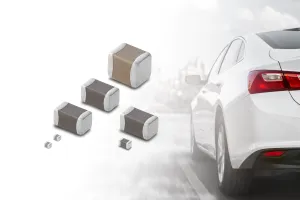
Murata Expands Automotive MLCC Lineup — 7 New Models Deliver Industry-Leading Capacitance for AD/ADAS Miniaturization
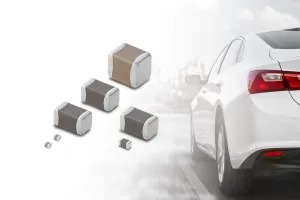
Product Announcement Overview
On April 8, 2026, Murata Manufacturing Co., Ltd. announced the start of mass production for 7 new automotive MLCC models. These are divided into two categories: low-rated-voltage MLCCs (2.5–4Vdc) for AD/ADAS IC peripheral circuits, and mid-rated-voltage MLCCs (25Vdc) for power supply lines, spanning package sizes from 0201inch (0603mm) to 1210inch (3225mm).
The flagship low-voltage model GCM32ED70G227MEC4 achieves 220μF in a 1210 package at 4Vdc, while the 100μF offering has been downsized from 1210 to 1206 (GCM31CD70G107ME36), reducing PCB footprint by approximately 36%. At the ultra-miniature end, the 0201inch model doubles capacitance from the previous 1μF to 2.2μF (GCM035D70E225ME02).
The mid-voltage series is equally impressive: GCM155D71E105KE36 delivers 25V/1μF in an 0402inch package, reducing PCB area by approximately 61% compared to the prior 0603 solution. The 1206inch 22μF model (GCM31CC71E226ME36) provides a compact, high-capacitance decoupling option for power rails. All models are AEC-Q200 qualified.
Technical Analysis — Materials and Process Breakthrough
The key enabler for these capacitance achievements is Murata's proprietary ceramic material micronization and homogenization technology. By developing finer dielectric powders with uniform particle distribution, thinner dielectric layers can be formed while maintaining automotive-grade reliability. This is especially critical for 0201inch devices — fitting 2.2μF inside a 0.6×0.3mm package demands exceptional thickness uniformity.
From an MLCC technology roadmap perspective, this reflects the industry-wide push toward higher capacitance density. X7T/X7S dielectric materials used in these models still exhibit DC bias derating — engineers should review the effective capacitance vs. DC bias curves to ensure adequate margin at the system's actual operating voltage. The 2.5–4V operating range helps mitigate this effect, but verification remains essential.
AD/ADAS Applications — Why These Matter
As autonomous driving progresses from L2 to L3+, the number and power consumption of SoCs, MCUs, and SerDes ICs in AD/ADAS systems continue to rise. A high-end ADAS SoC can draw tens of amps of peak current, requiring numerous MLCCs around the IC for transient decoupling. The 2.5–4V rated voltage aligns perfectly with modern digital IC core supply rails (0.8–3.3V), while 100–220μF capacitance values provide superior transient response.
PCB space is at a premium in AD/ADAS modules — camera modules, radar sensors, and other size-constrained applications benefit from 0201inch 2.2μF decoupling capacitors that can be placed directly on the IC backside or between BGA pads, minimizing trace length and parasitic inductance. The 0402inch 1μF/25V device is ideal for sensor module input filtering, replacing legacy 0603 solutions.
Supply Chain and Procurement Impact
As the world's largest MLCC manufacturer, Murata's automotive line expansion has direct supply chain implications. NEV penetration continues to rise in 2026, and automotive MLCC demand remains strong with capacity utilization above 85% for mainstream types. These 7 new models target the high-growth AD/ADAS segment, and initial supply is expected to prioritize Tier-1 customers.
For teams with small-to-medium procurement volumes, we recommend early alternative-part qualification. Comparable automotive MLCCs include the TDK CGA series, Samsung Electro-Mechanics CL31/CL32 series, Yageo AC series, and Walsin WF series. For ultra-small 0201 and 0402 automotive MLCCs where supplier concentration is high, locking in 6–12 month procurement agreements is recommended to ensure supply stability.
Movthing, as a distributor specializing in SMD capacitors, maintains close partnerships with Murata, TDK, Samsung, Yageo, and other major MLCC manufacturers. We assist clients with new product samples, datasheet interpretation, and alternative-part recommendations to help procurement and R&D teams complete BOM verification efficiently.
Quick Reference — New Models
| Part Number | Rated Voltage | Package | Capacitance | Application |
|---|---|---|---|---|
| GCM035D70E225ME02 | 2.5Vdc | 0201inch | 2.2μF | AD/ADAS IC decoupling |
| GCM31CD70E107ME36 | 2.5Vdc | 1206inch | 100μF | IC power rail decoupling |
| GCM035D70G225MEC2 | 4Vdc | 0201inch | 2.2μF | Sensor modules |
| GCM31CD70G107ME36 | 4Vdc | 1206inch | 100μF | Domain controllers |
| GCM32ED70G227MEC4 | 4Vdc | 1210inch | 220μF | Domain controllers / high-current rails |
| GCM155D71E105KE36 | 25Vdc | 0402inch | 1μF | Power input filtering |
| GCM31CC71E226ME36 | 25Vdc | 1206inch | 22μF | Power line decoupling |
All models operate over -55°C to +125°C (X7T/X7S characteristics) and are AEC-Q200 qualified. When selecting, consult the DC bias characteristics — especially for low-voltage models — to verify effective capacitance at operating voltage.
Murata's 7 new automotive MLCCs span the full range from ultra-small decoupling to high-capacitance power rail filtering, underscoring the trend toward higher capacitance density and miniaturization in the automotive sector. Movthing will continue monitoring MLCC manufacturers' capacity and new product releases to provide timely supply chain intelligence and technical support. Contact our engineering team for datasheets or samples.