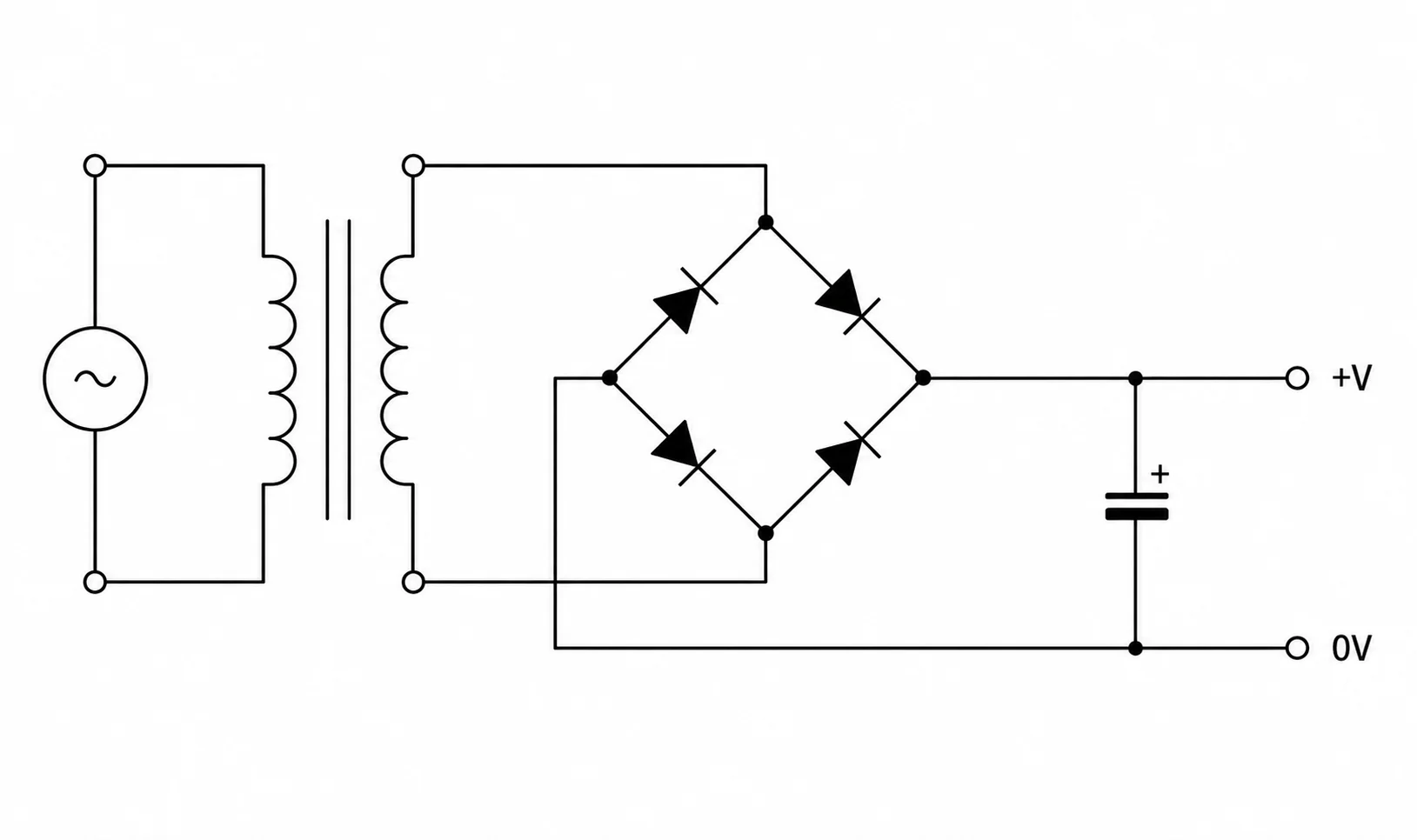
Bridge Rectifier & Capacitor Filter Circuit Design Guide
The bridge rectifier with capacitor filter is the most widely used AC-to-DC conversion circuit in electronics. It sits inside every linear power supply, battery charger, and LED driver. The design looks simple—four diodes and a capacitor—but getting the component values right requires understanding the physics behind each part.
How the Circuit Works
A bridge rectifier converts alternating current into pulsating direct current using four diodes arranged in a bridge configuration. During each half-cycle of the AC input, two diodes conduct, directing current through the load in the same direction.
Without a filter capacitor, the output is a series of half-sine pulses at twice the input frequency (100Hz for 50Hz mains, 120Hz for 60Hz). The capacitor smooths this by charging to peak voltage during the conduction interval and discharging into the load between peaks.
Core Design Equations
DC Output Voltage
For a full-wave bridge rectifier with a filter capacitor:
Vdc(no load) = Vpeak = Vrms × 1.414
Vdc(loaded) ≈ Vpeak × 0.9 to 1.2 (depends on capacitor size and load)
For a 12V AC transformer winding, expect roughly 15-16V DC output at light loads.
Ripple Voltage
The capacitor discharges between AC peaks according to:
Vripple(peak-to-peak) = Iload / (f × C)
where f is the ripple frequency (100Hz for 50Hz mains, 120Hz for 60Hz), C is the capacitance in farads, and Iload is the load current in amps.
Design example: A 1A load, 120Hz ripple frequency, and 4700µF capacitor yields:
Vripple = 1 / (120 × 0.0047) = 1.77V peak-to-peak
To reduce ripple to 100mV under the same load, you'd need approximately 83,000µF—which is why voltage regulators typically follow the filter capacitor in precision designs.
Transformer RMS Current
The transformer secondary must supply both the DC load current and the capacitor charging current. The RMS secondary current is higher than the DC output:
Irms(secondary) ≈ Iload × 1.6 to 1.8
This multiplier accounts for the high peak-to-average ratio of the capacitor charging current pulses. For a 1A DC output, the transformer secondary winding needs to handle at least 1.6A RMS.
Capacitor Selection
Capacitance
Pick ripple voltage first, then calculate minimum capacitance:
C(min) = Iload / (f × Vripple(allowed))
For a 1A supply with 1V ripple at 120Hz:
C = 1 / (120 × 1) = 8,333µF
Choose the next standard value: 10,000µF.
Voltage Rating
The capacitor must withstand the peak voltage plus safety margin:
Vrating ≥ Vpeak × 1.3
For a 12Vrms transformer (16.9V peak), use a 25V rated capacitor minimum. Higher voltage ratings also reduce DC bias derating in MLCCs, making the capacitor more effective at the operating voltage.
Capacitor Type Selection
| Application | Recommended Type | Why |
|---|---|---|
| Bulk filtering (mains frequency) | Aluminum electrolytic | High capacitance per volume, low cost |
| High-frequency ripple (switching supplies) | MLCC (X7R/X5R) | Low ESR, handles high-frequency ripple |
| Mixed filtering | Electrolytic + MLCC in parallel | Electrolytic for bulk, MLCC for high-frequency bypass |
| High-reliability | Tantalum or aluminum polymer | Longer life, lower ESR than standard electrolytic |
For most linear power supplies, a large aluminum electrolytic (1,000-10,000µF) provides bulk filtering. Adding a 0.1µF MLCC in parallel suppresses high-frequency noise that the electrolytic cannot handle due to its higher ESL.
Browse aluminum electrolytic and MLCC capacitors for power supply designs.
Ripple Current Rating
The capacitor must handle the RMS ripple current without overheating. For aluminum electrolytics, ripple current rating is a critical parameter—exceeding it shortens life dramatically. A good rule of thumb: the capacitor's ripple current rating should be at least 1.5× the calculated RMS ripple.
Diode Selection
Peak Inverse Voltage (PIV)
Each diode in the bridge must block the full peak voltage:
PIV ≥ Vpeak × 1.5 (safety margin)
For a 12Vrms transformer: PIV ≥ 17 × 1.5 = 26V. Standard 1N4001 (50V PIV) diodes are plenty.
Surge Current
At power-on, the discharged filter capacitor looks like a short circuit. Diodes must survive the inrush current:
Isurge = Vpeak / (transformer resistance + ESR of capacitor)
A transformer with 0.5Ω secondary resistance and a capacitor with 0.05Ω ESR gives:
Isurge = 17 / 0.55 ≈ 31A
Standard 1N400x series diodes handle 30A surge for one half-cycle. For larger capacitors, use higher-surge diodes or add an NTC thermistor for inrush limiting.
Practical Design Tips
1. Keep the capacitor close to the rectifier. Every centimeter of trace between the rectifier output and the filter capacitor adds inductance that degrades filtering. Place the capacitor as close as physically possible.
2. Use a bleeder resistor across the capacitor. A 100kΩ-1MΩ resistor discharges the capacitor when power is removed. Without it, a large electrolytic can hold charge for hours—enough to damage components or injure someone working on the board.
Rbleed = V² / P, choose P ≈ 0.25W for safety
3. Derate electrolytic capacitors for temperature. A capacitor rated for 2,000 hours at 85°C will last approximately 16,000 hours at 65°C, and only 1,000 hours at 105°C. Temperature is the dominant factor in electrolytic capacitor lifetime.
4. Add a small MLCC in parallel with the electrolytic. A 0.1µF X7R MLCC placed directly across the electrolytic terminals shunts high-frequency noise that the electrolytic's ESL prevents it from filtering.
5. For the first prototype, measure. Calculate your ripple, then verify with an oscilloscope. Capacitor ESR varies with temperature and frequency. Real measurements typically differ from calculated values by 20-40%.
Common Design Mistakes
- Undersizing the capacitor by only looking at capacitance. A 4700µF capacitor with 2Ω ESR will have 10× the ripple of a 4700µF capacitor with 0.2Ω ESR. Always check ESR.
- Forgetting the inrush current. Large filter capacitors draw massive current at startup. Size diodes and fuses accordingly.
- Using the wrong capacitor type. MLCCs at 50V rating can lose 60% of their capacitance under DC bias. A 10µF MLCC may deliver only 4µF in circuit.
- Ignoring transformer regulation. Small transformers can have 20-30% regulation, meaning the no-load voltage is significantly higher than rated.
Complete Design Example: 12V 1A Linear Supply
| Parameter | Value |
|---|---|
| Transformer | 12Vrms, 2A secondary |
| Rectifier | 4× 1N4002 (100V PIV) |
| Bulk filter capacitor | 10,000µF / 25V aluminum electrolytic |
| HF bypass capacitor | 0.1µF X7R MLCC (25V+) in parallel |
| Ripple (calculated) | ~0.83Vpp at 1A load |
| Bleeder resistor | 220kΩ / 0.5W |
For the complete part selection, browse our capacitor catalog with 3,700+ MLCCs across 8 manufacturers, plus inductors and EMI filters for the post-regulation stage.